
The House That Broke the Neighborhood — and the Marketing Insight It Accidentally Revealed

A three-story addition on Marble Lane in Fairfax has divided the neighborhood and raised new concerns about blind spots in the building code of the region’s largest county. (Kyle Swenson/The Washington Post)
Let me start with the wild story coming out of Fairfax, Virginia — because it perfectly illustrates a marketing truth most creators and online business owners overlook until it’s too late.
The Setup (AKA: How a House Grew into a PR Nightmare)
On a quiet street in Fairfax, one homeowner, Mike Nguyen, decided to build a big home addition — and I mean big. Three stories tall, 60 feet long, towering over the neighbor’s yard like a personal hotel wing. His goal was wholesome: Make space for his elderly parents and growing kids so they could all live together.
His neighbor, Courtney Leonard, didn’t think much of it at first… until the addition started swallowing the sunlight on her property. Her bright, cheerful suburban home now sits in the shadow of what the internet has snarkily dubbed “the townhouse that ate the neighborhood.” One real estate agent even told her the structure may have knocked her home’s value from the $800,000s down to the $500,000s — courtesy of this unexpected behemoth next door.
She complained to the county. The county initially said, “Everything’s fine.”
She pushed back.
She went to the media.
Then it blew up.
One news spot turned into more news spots. People drove by to take photos. Facebook threads erupted. Radio stations discussed it. A county supervisor stepped in. A second inspection revealed the addition was actually six inches too close to the property line. Construction is now halted, neighbors are miserable and officials are scrambling. We’re talking total chaos, all from one house addition that nobody outside Marble Lane had ever heard of a month ago.
Now the whole street has become a sightseeing attraction for strangers who pull up, roll down their windows, and yell opinions before driving away.
You truly cannot make this stuff up.
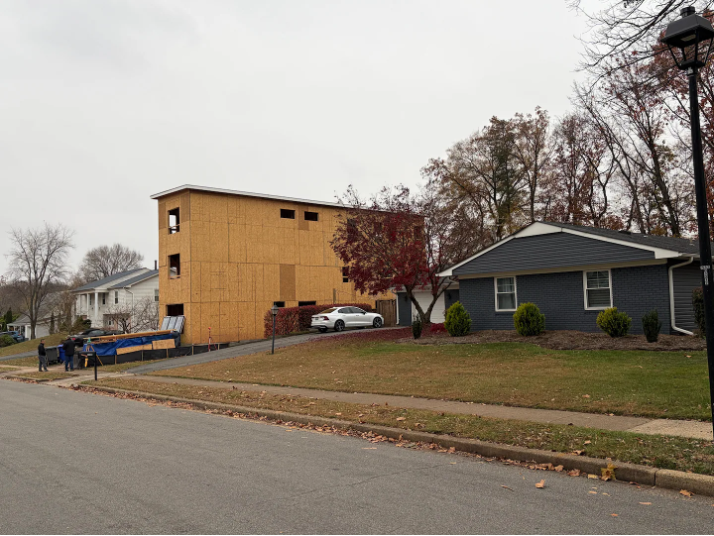
Neighbor Courtney Leonard believes the new construction has dramatically dropped the value of her own home. Owner Mike Nguyen said he had no intention of hurting neighbors or causing the dispute. (Kyle Swenson/The Washington Post)
Now the Marketing Lesson Hidden Inside the Mayhem
For online marketers, this story is more than neighborhood drama. It’s a perfect snapshot of how attention actually works today.
- Attention doesn’t care about your intentions.
Nobody involved wanted publicity. Not the builder. Not the neighbor. Not the county.
But the story had the three ingredients that fuel modern engagement:
- A visual shock factor (giant house looming over tiny house)
- Clashing perspectives (good son vs. wronged neighbor)
- A “this feels unfair” trigger (lost sunlight, dropped home value)
You don’t need to seek attention.
If something strikes the public as surprising, emotional, or unfair — attention finds you.
This is why brands with the most viral stories often didn’t plan them… and why the most carefully crafted campaigns often flop.
- The internet rewards emotional friction, not fairness.
Everyone online wants a side to pick. A hero to defend. A villain to roast.
That’s why bland content goes nowhere: it asks nothing of the audience.
This Fairfax story forces people to choose:
“Team Nguyen — he’s caring for his parents!”
“Team Leonard — her home value tanked!”
“Team Zoning Code — fix your blind spots!”
It’s a tension loop — and tension is engagement.
- If you don’t shape the narrative early, the public will shape it for you.
By the time officials responded, the internet already had its opinion.
And once strangers are driving by screaming out of their car windows, let’s just say the narrative is no longer yours.
The marketing translation:
If you don’t tell your story clearly and early, your audience will fill in the gaps — usually in the least flattering way possible.
- Disruption always casts a shadow somewhere.
When you grow, someone feels it.
When you change direction, someone doesn’t like it.
When you stand out, someone thinks you’re “too much.”
Sunlight loss is simply a physical metaphor for market disruption:
Your growth will always cast a shadow — the goal is to ensure you’re the one explaining why it matters.
The Takeaway for Online Marketers
This isn’t really a story about a house.
It’s a story about visibility, narrative, and control — the three pillars of modern marketing.
- Create content with emotional friction.
- Don’t be afraid of strong angles.
- Tell your story before someone else does.
- And remember: attention comes from tension, not perfection.
Story Source: https://www.washingtonpost.com/dc-md-va/2025/11/22/fairfax-virginia-housing-addition-dispute/
Claim Your Free MP3 And PDF Training: The 3-Part Plan To Topping $100,000 Per Year In Profit
Enter your name and email address below to receive a new lesson delivered to your inbox once a week. Your first lesson will be delivered immediately.

Privacy Policy : We value your privacy. You can unsubscribe from receiving future emails with 1 click at any time.